

Everything, Everywhere, All at Once:
An Introduction to Dependent Origination
This event has ended. You can listen to the dharma talk by Zuisei Goddard, Everything, Everywhere, All at Once: An Introduction to Dependent Origination here. A written introduction to this Buddhist teaching is also available below.
When
Saturday, February 21
9 AM–12 PM EST
(Zazen optional)
What
Online Class | Dependent Origination
with Zuisei Goddard
Cost
Tiered Pricing
Supporting $50 | Sustaining $25 | Scholarship $15
Dive into the heart of Dependent Origination (pratityasamutpada), and see its relationship to both liberation and our modern everyday lives. This live online class is led by Guiding Teacher Zuisei Goddard.
Dependent Origination or dependent arising explains how all things come to be, how they change, and how they pass, showing that all phenomena arise from an infinite, dynamic, and interdependent network of causes and conditions. Nothing—absolutely nothing—exists by itself. Join us to look closely at this teaching and the ways it can bring about our liberation.
The course opens with an optional hour of zazen (silent meditation). Please note that although everyone is encouraged to join us for zazen, if you’re unable to come for the three hours and just want to attend the class, you’re welcome to do that.
Schedule
Banner photo by A.C.
A description on the teaching of Dependent Origination is available below.
The live class will go further and include an optional period of zazen, and a Q&A with Zuisei Goddard, Guiding Teacher of OMS.
Dependent Origination
Causes and Conditions
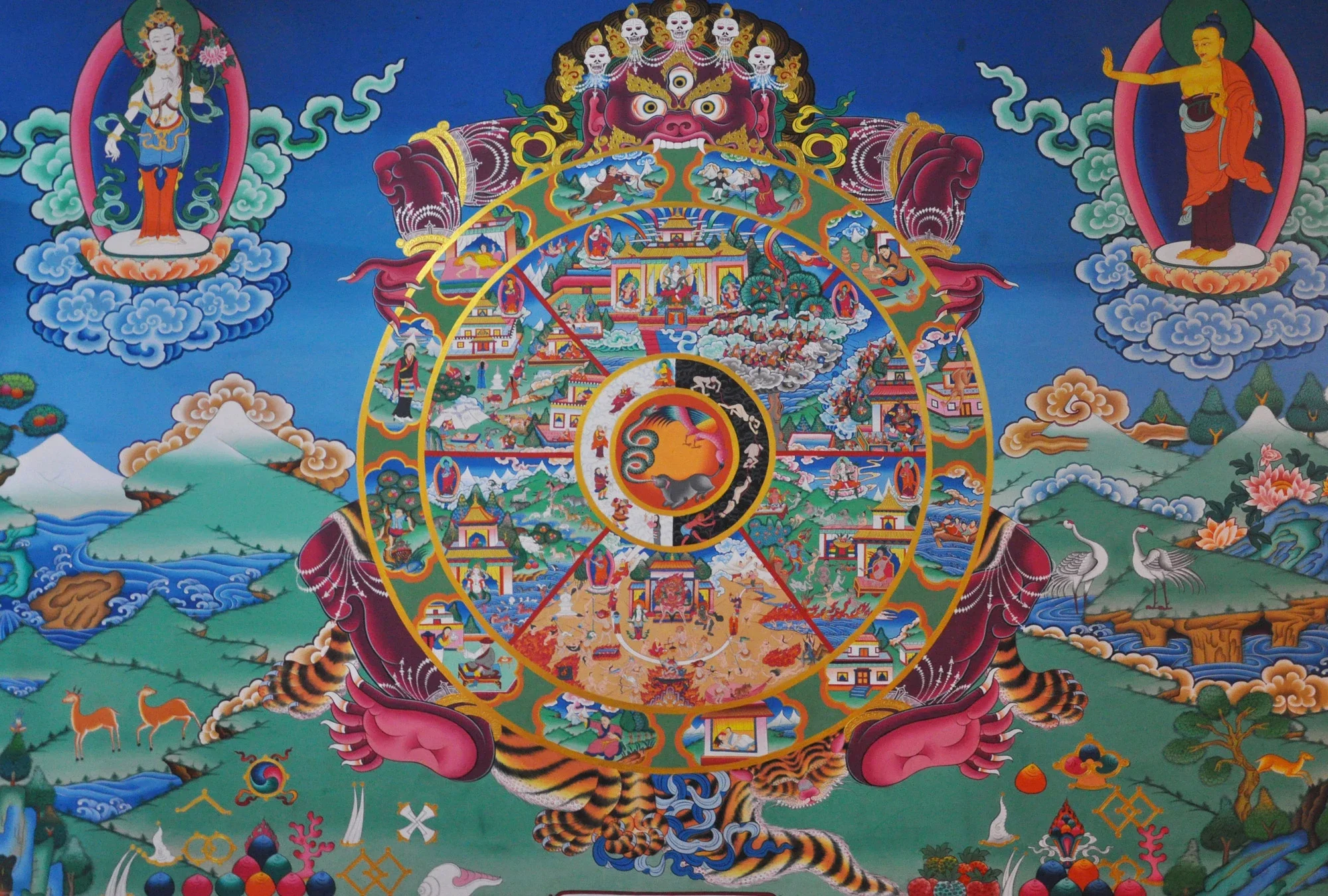
The Buddhist teaching on dependent origination (Skt. pratityasamutpada) points to the fact that nothing exists on its own—nothing, including us—can be itself by itself. Instead, we and everything we perceive are a combination of causes and conditions coming together, shifting, and passing away. This cycle of never-ending causes and conditions is samsara. On the other hand, we realize enlightenment when we see through this chain, braking it open. The Buddha offered a simple formula to describe dependent origination:
When this is, that is.
From the arising of this comes the arising of that.
When this isn't, that isn't.
From the cessation of this comes the cessation of that. †
Dynamic Interdependence
From this we can see that everything in the world is interconnected and constantly changing, from our thoughts to our relationships, our actions and their effects, and even our sense of self. When one thing arises, another rises from that. In fact, each thing that arises, arises not from one single cause but from another set of conditions, and each of those conditions arises from another set, and so on. That is why we can say it takes an entire universe to make a flower, a flowing river, a passing thought.
In The Heart of the Buddha's Teaching: Transforming Suffering into Peace, Joy, and Liberation Thich Nhat Hanh says of a flower:
The beautiful flower does not become empty when it fades and dies. It is already empty, in its essence. Looking deeply, we see that the flower is made of non-flower elements—light, space, clouds, earth, and consciousness. It is empty of a separate, independent self.
As we are made of our many causes and conditions, then we too are already empty of self nature, and from this realization compassion is born. When we see that everything needs everything else to be what it is, we can appreciate ourselves as we are, and also others as they are—lives flowing interdependently and changing moment to moment.
Ignorance and Samsara

Photo by Karine Avetisyan
The twelve links in the “chain” of dependent origination describe the way existence comes into being.††† The first here, ignorance, is the “prime mover” in Buddhism. From ignorance comes the “whole mass of suffering,” as the Buddha called it, because it gets the wheel of samsara rolling. ††Ignorance is not understanding things as they are. Wisdom, it’s opposite, is seeing the nature of things. As Bhikkhu Bodhi says, “…when ignorance comes to an end, the entire network of conditions also ends.”
Dependent Origination From Study to Practice
Once we’re aware that everything we perceive is a combination of causes and conditions coming together, shifting, and passing away, how do we practice for the benefit of the world? First of all, remembering that even though we can’t control what happens to us, we can always choose how to respond. Then we can use practices like the Four Immeasurables or the Six Paramitas, the Four Vows and the Four Noble Truths. And as we put these tools into practice over time, our clarity, compassion, and wisdom will expand.
† This verse is taken from the “Third Watch” of the Bodhi Sutta in the Udana (Ud 1:3 Awakening (3) (Bodhi Sutta)). The Udana is a collection of suttas in the Khuddaka Nikaya of the Pali Canon.
†† In Buddhism, "ignorance" often refers to ignorance of the Four Noble Truths—in particular that life is dukkha. Ignorance also refers to ignorance of anatman--the teaching that there is no "self" in the sense of a permanent, integral, autonomous being within an individual existence.
††† The Twelve Links of Dependent Origination are as follows: (1) Ignorance, see footnote above, (2) Volitional Action: Samskara, impulses born of ignorance that lead to action, (3) Conditioned Consciousness: Vijana, basic awareness faculties of the six senses (eye, ear, nose, tongue, body, mind), (4) Name-and-Form: Nama-rupa, the moment when matter (rupa) joins mind (nama) to form the illusion of an independent existence, (5) The Six Senses: Sadayatana, the six senses arising, (6) Sense Impressions: Sparsha, contact between the basic awareness faculties and the outer world, (7) Feelings: Vedana, recognition and experience of the preceding sense impressions as feelings—pleasant, unpleasant or neutral, (8) Desire or Craving: Trishna, desire and aversion arising, the cause of stress or suffering, (9) Attachment: Upadana, the attached and clinging mind, its force keeps one bonded to the life of samsara, (10) Becoming: Bhava, the new becoming, its force propels one along the cycle of endless rebirth (11) Birth: Jati, birth or rebirth in to a samsaric life, (12) Old Age and Death: Jara-maranam, the dissolution of what came to be.