

Ancestors (with Hojin Sensei)
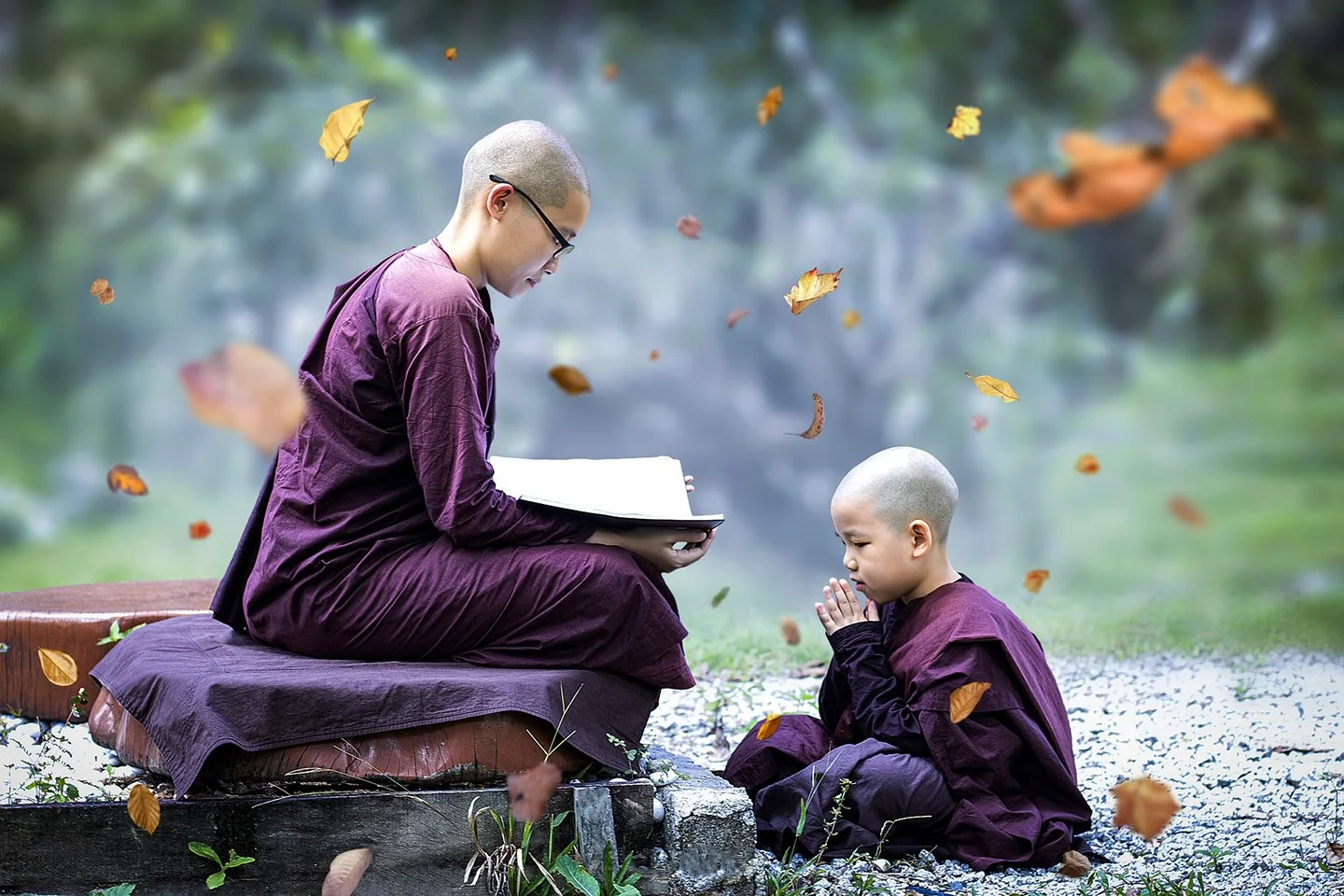
Photo by truthseeker08
We are never practicing alone—not in the darkest pit of hell, not in the brightest state of bliss. When we know this, the natural response is to bring forth our buddha ancestors and look at them in veneration. We formally bow and meet them, which is none other than meeting ourselves.
Zuisei and Hojin Sensei speak about the importance of honoring and connecting to our ancestors in spiritual practice. This talk was given at Zen Mountain Monastery’s Annual Women’s Sesshin, Wild Grasses.
This talk was given by Zuisei Goddard.
Transcript
This transcript is based on Zuisei's talk notes and may differ slightly from the final talk.
Ancestors with Hojin Sensei
The Pointer, offered by Hafiz. The subject tonight is love, and for tomorrow night as well. As a matter of fact, I know no better topic for us to discuss until we die.
Preface to the Assembly, offered by David Abram. There are so many unsung heroines and heroes at this broken moment in our collective story, so many courageous persons who, unbeknownst to themselves, are holding the world by their resolute love or contagious joy. Although I do not know your names, I can feel you out there.
This weekend, we are ending a Wild Grasses retreat, and it's our annual Women's Session. Hojin Sensei will speak a little bit about the name and how it came about, so I won't do that. A couple of days ago, I said to the women that throughout the weekend, we were walking a live line between tradition and investigation, that we were looking at some of these ancient forms and also seeing, studying how some of them could perhaps be adapted to better suit this particular manifestation, this female body, this female mind. We've never done this, actually. I like it. So far so good.
One of the things we did, in keeping with the theme of the Ango, is invite our female ancestors into the room. We invited them into this training hall. We shared some of their stories. Hojin Sensei chanted their poems, some of their poems. We sat and worked and ate alongside them.
Roots of Place, Family and Tradition
We can think of ancestors in many different ways, but let me offer three overlapping spheres, three kind of overarching categories. There's our ancestors by virtue of place, by virtue of blood, and by virtue of tradition.
Our ancestors by virtue of place are those with whom we share the land. In this case, they are in fact the land which they and we inhabit. Unfortunately, many of us no longer live in the land where we were born, for example, and so that connection becomes more distant. When this ancestry is connected and it's embodied, it is in fact intimately connected to the land. It is not unusual, not a surprise, that the more distant we become, the more disembodied, alienated we feel. Like in our culture, this pervasive sense of being displaced or misplaced even within this body, this particular tract of land.
Our ancestors understood very well that you cannot live without land. You can't really be apart from it. You can certainly place layers and layers of cement or distance between you and it in an effort to buffer yourself from what is too raw, too ungoverned about the land you inhabit. But you can also turn toward it and learn to move with its rhythm.
A few days ago, I was telling one of the residents, there's a place in southern Mexico, all the way south, where there's a pyramid called the pyramid of Chichen Itza. Every spring and fall, equinoxes are marked by the descent of this plumed serpent, all the way from the top of the pyramid to its bottom. What happens is that as the sun reaches its zenith, this perfectly formed snake, plumed serpent of light and shadow, descends the steps of the pyramid. It takes five hours for it to get all the way down. It remains in place for forty-five minutes. Then it begins to descend, so the tail slowly begins to come down until it disappears into the ground.
I think of this someone or someones with this precise mathematical knowledge, architectural knowledge, astronomical knowledge, who conceived of this idea and went to all the trouble to execute it. They know that some six hundred years later people would still be gathering from all over the world to witness this beautiful, very simple, mysterious creation. Even if they didn't think in this way, they still thought it worthwhile to spend their time and energy, their effort to create this. If I'm despairing of human nature, I think of things like this.
Our blood ancestors are our family, the people that we are tied to through blood and guts and sweat and toil, the final frontier of practice, I call family. They give us our history, they give us our look, our aspects of our personality, our inclinations, in many ways our ways of seeing the world. This connection is a very intimate connection, even when it is a troubled one. They are, after all, in our blood, as we are in theirs.
These are people whom we love, people whom at times we can't stand, but whom we cannot really ever be separated from, for better or for worse. I was remembering, as I was writing this, a little bit of an odd memory. I remembered that when my brother and I were very young, my mother would every now and then joke, rather darkly, I think, that she had found me in the woods and my brother behind a dumpster, and that she had felt sorry for us and she picked us up and decided to raise us. I couldn't remember why she would say this. What was the purpose? She said it jokingly.
The only reason she could do it and we wouldn't just completely freak out is because my brother and I looked so alike that people thought we were twins. He was the spitting image of my mother, and I'm the spitting image of my father. So clearly we were flesh and blood. Love, that of your blood, ancestors.
With that odd memory, which I hadn't had in a very long time, I also felt very much the presence of my mother. She's been dead for twenty-five years. I still feel her and hear her.
It's interesting that the Buddhist teachings say that we choose our parents, which, depending on your relationship with them, may be difficult to accept. One theory is that we choose them, that we choose people that we're actually already related to through our karma, and that we're trying, by coming into the world in their presence, to work things out, to continue to develop, to clarify, and hopefully eventually break free of these very tightly tied knots sometimes.
Our ancestors by tradition are those whose footsteps we follow, whose breath is our breath, whose practice we enliven every time we sit down on the cushion, every time we engage the teachings, every time we turn toward the precepts and ask how to clarify them in our own lives. These are the ancestors by tradition, the ancestors who have handed down the robe and bowl generation after generation. These are the people who have practiced before us and because of whom we are practicing now.
We always think of the patriarchs: the monks and nuns, men and women who came before. In this case, we wanted to consciously bring in the female ancestors so we could sit with them, so we could remember them, so we could practice with them. Not because practice is different for a man and a woman, but because the conditions are different. They have been different historically. They are different today.
We can have a different kind of access or lack of access, a different kind of encouragement or lack of encouragement. Historically and today, the challenges, expectations, possibilities may be different. The practice itself is not different. The conditions we travel through may be different.
The wonderful thing about ancestors, however you define them, is that they want you to surpass them. They want you to move beyond whatever limitations they had, whatever insights they arrived at. They want you to move beyond those. When you do, you honor them directly. You respond to their deepest wish, which is actually your deepest wish as well.
Walking the Line: Tradition, Practice, Presence
At the beginning of the weekend, yesterday morning, I said that we would be walking a live line between the tradition and our own personal investigation, our own consideration of both what was handed down and what we are discovering. Our broad theme being our idea, our activity of Ango, which is very strongly tied to the female ancestors.
Tradition versus investigation: not that they are in opposition to each other, but how do they inform each other? How do they dance together? This is part of the practice. This is part of the life of the practice.
Yesterday we talked about the female ancestors. One of the things we did was chant some of their poems. One of them, one of the most well-known perhaps, is this very short poem attributed to Moshan, one of the female ancestors, one of the first female ancestors in our tradition who was recognized as a teacher in her own right, independent of anyone else.
This poem goes something like: “Meeting or not meeting, both are okay. What is there to be anxious about?” This is a very short poem, but incredibly deep. It is very simple. It is very direct. It’s very clear. Meeting or not meeting, both are okay. What is there to be anxious about?
When we chant these poems, when we bring forth these voices from the past, we are not only remembering them, we’re allowing them to inform our own practice, our own breath, our own posture. We’re allowing them to speak through us, which they do. We allow them to enliven our own practice, the way that we’re living today.
In talking about ancestors, I was remembering something that happened many years ago when I was first practicing. It was my second or third Ango. I was still fairly new, and I was taking this poem by Case 43, “Shuzan’s Short Staff.” The pointer talks about ancestors and talks about the robe, and the verse also talks about ancestors and the robe. I remember having this sense of sitting with all of my ancestors. It was a very odd sense because I had never thought about ancestors in that way.
I felt surrounded by all these people who had come before me. I felt that they were supporting me, even though I didn’t know any of them except one or two by name and maybe by a little bit of biography. But I felt very supported by them in that moment.
I shared this with Shinge Roshi at the time, and she said, “Yes, of course. They are practicing with you.” That stayed with me. It stayed with me because it was not something I had thought about, but in that moment it felt very real. It felt very immediate. It felt very supportive.
Then there are ancestors by virtue of our tradition, and these are those with whom we share a spiritual practice, and therefore a common aspiration, recognized or not, stated or implicit, clear or not. There are different kinds of blood lineage. I was reflecting in the week that I was involved in the work leading up to the transmission. There was a lot of bowing to the ancestors—a lot of bowing several times a day to the women ancestors, the male ancestors. After the second day, you feel—you can't help but feel yourself in the midst of this stream. You're completely immersed in it. This thread extends backwards, all of these many generations, and extends, hopefully, forward, all of these many generations. You feel this line.
Of course, for most of these people, whom you've never met, and yet you have, you feel that you have—that you are with them in that room doing those bows. They are there with you. The only place actually where they live. St. Augustine called, he coined this term, the constant present. He said if you take the smallest unit of time that would be indivisible, that's the present. But he said it's not only that: that single instant contains all of the past and all of the future, and is what, in fact, connects it. Not only connects it, but contains it, holds it.
This is also, of course, a very Buddhist view. We say that a single moment contains a thousand kalpas. A thousand kalpas in a single moment. Likewise, our ancestors exist only and always now, which means they can never leave us. They are never apart. Actualizing Buddha ancestors means to bring them forth and look at them in veneration. It is not limited to Buddhas of the past, present, and future, but it is going beyond Buddhas who are going beyond themselves. It is taking up those who have maintained the face and eye of Buddha ancestors, formally bowing and meeting them. They have manifested the virtue of the Buddha ancestors, dwelt in it, and actualized it in the body.
The wonderful thing about ancestors, however you define them, is that they want you to surpass them.
We are, of course, working with this passage for the Ango. This bringing forth of Buddha ancestors happens with the body and it happens with the mind. Of course—how else? How else could it take place? Every day, we invite our ancestors into this room, into our homes, through our liturgy, through the act of sitting in the same exact posture that they have sat in generation after generation, through erasing of the body-mind, through choosing clarity over confusion. Part of the work that they do, simply by reason of their being, their existence, is to remind us that what we're doing is not new.
This practice is not new. Our struggles aren't new. Freedom from those struggles is not new either. It is not insignificant to realize. To know in the midst of the tumult of your mind that thousands, if not millions, of people have gone through something similar, if not exactly like what you're going through. If they pass through it, you can too. Even a small gesture, when our teacher nods as we're speaking about some difficulty or other, and they say, yes, I know what you mean, can give us an enormous sense of confidence or assurance.
Oh, I mean, I'm not unique. There's nothing inherently wrong with me. I'm not failing in my practice. I'm just caught. I can't see the way through right now, but I will. Again, we're never practicing alone—not even in the darkest pit of hell or in the highest, brightest state of bliss. When we know this, I believe that the natural response is to bring forth our Buddha ancestors and to look at them in veneration, to formally bow and meet them, which is none other than meeting ourselves.
But what does it really mean to regard oneself and to regard others with veneration? One of my favorite ancestors is Bodhisattva Never Disparaging, who appears in the Lotus Sutra. It says that this monk, whenever he would meet someone—monk, nun, layman, laywoman—would bow in obeisance to them. He would speak words of praise, saying, "I have profound reverence for you. I would never dare disparage you." Why? Because you are all practicing the Bodhisattva way and are certain to attain Buddhahood.
When people would hear this, they would become enraged. How dare he predict Buddhahood for us? Who does he think he is? They would throw stones at him, they would hit him with sticks, he would run to the other side of the road from a safe distance, yelling, "I would never dare disparage you. Because you too will attain Buddhahood." This is just one of the many Buddha ancestors worth venerating and emulating, I think. One steadfast conviction, a virtue worth manifesting in this moment, and in this moment, and in this moment—in that constant presence, a present, which is the only place where practice and realization are actualized.
This great love of the Buddhas and ancestors—what is this that we feel from both people, these ways that Zuisei said: this land, these mountains, these rivers, the love that's offered and that we receive for our life, that holds the world together? Meeting and healing with our ancestors requires that we encounter all of these things inside ourselves and understand the connections between who we are today and who they were and what they are. If there are people back there who need working with, this is our chance. If there is land back there that needs working with, this is our chance.
Having the opportunity to connect with the Buddha Dharma with this practice, we have a chance—especially through Zazen—to do the deep work of understanding how we got to be in whatever weirdness we are, whatever weirdness you are in. For me, the relationship with the ancestors is inspired by having this desire to have an ongoing relationship with this world, with everything in it. The ancestors' wisdom is unusual, partly because they are no longer trapped in this body, the people.
I always saw this as an employment opportunity: our ancestors have a job, they need employment. They are always ready to engage as soon as we turn towards them. They want us to continue awakening to the greatest potential as humans. They want us to help them resolve the mistakes they made and left us with messes, to help us work better with our own mistakes. That is their wisdom. How to carry it forth in how we live in harmony with things. If you don't have a job, you actually do too. We're all employed. We're all still involved.
We've been shaped not only by our human ancestors but by the environments in which they lived. The sooner we get started, the better. The Buddha started over 2,500 years ago. He simply sat down and clearly saw the situation, the nature of things, and then he just started to talk to people about it, telling them what he saw. He explained what he understood. In turn, they taught others, and they taught others, and they taught others. This is what we call lineage.
In his awakening, he had that experience: he can't help but always see another as himself. I spoke about this yesterday. This is one of my "ask-its" for my life—that I always see one and the other as myself. This is why we say their names, bring them to life, to see another, to see ourselves. What is the great love of Buddha ancestors? Practicing the Buddha's Dharma—that's what we're doing here today. All engaging, discovering ourselves to be in a great flowing river of continuities.
Living Through the Lineage
Part of our task is to discover how our ancestors inform our lives and continue to be here in our hearts and minds. From the book The Buddha by Karen Armstrong, she writes: the Dharma is essentially a method; it stands or falls not by its metaphysicality or acuity or its scientific accuracy, but by the extent to which it works. The truths claim to bring suffering to an end, not because people subscribe to a salvistic creed or to certain beliefs, but because they adopt the Buddhist program or way of life.
Over the centuries, people have indeed found that this regimen has brought them a measure of peace and insight. They have realized that by reaching beyond themselves to a reality that transcends their rational understanding, they become fully human. For the Buddha, this was a fact. For him, his method worked, and we're offered to explore it. Does it work for you? How do you know?
In Zazen, we place ourselves on the seat in our Buddha nature that's never apart from us. I feel there, at least, I can recite any lineage in gratitude—any lineage. The earth, my family, my ancestors—they're all there, aren't they, when we sit down? Your whole family is sitting with you, sometimes in ways you'd like them to leave, but to be in awe and surprise, with humility, with love. We go after ourselves, like something—we did something wrong.
As long as we practice, none of our ancestors are dead. Our fathers are alive, our mothers are alive. The trees we've lost, mountains, rivers are alive. The breath, the depth of the teaching, is seeing that when we expand our ancestry in every way, every line of every species is our line. They're all our ancestors. Telling, retelling, shaping, reshaping, we can return to the stories, the history, and question, is this true? Verify it. See how it works for you. Me, in doing so, will change ourselves, change the world, change each other.
There are so many unsung heroines and heroes at this broken moment in our collective story. So many courageous persons who, unbeknownst to themselves, are holding together the world by their resolute love and contagious joy. Although I do not know your names, I can feel you out there. The ancestors didn’t go cold. They stayed in the fires of samsara, in the craziness, to help, to help themselves, and know that they can’t be liberated without everyone coming along.
The Buddha had it, you know. When he realized himself, he went into the forest for a while, wondering if he should, if he could do it, if anybody would actually see what was real and true—the so much cloudiness. Of course, guess what? He returned.
I love this story with Vimalakirti, in the Vimalakirti Sutra, who was a layman, a lay householder with a wife and children. It was said that he had the realization that was equal to the Buddha. It's where our white robe comes from. He wore a white robe. He begins the Sutra by describing to Manjushri, one of the great luminaries, the insubstantibility of things.
Manjushri, a Bodhisattva, should regard all living beings as wise ones, as wise ones regard the reflections of the moon in water, as magicians regard people created by magic, like a face in a mirror, like water in a mirage, like the sound of an echo, like a mass of clouds in the sky, like the previous moment of a ball of foam, like the appearance and disappearance of a bubble of water—all these very fragile, momentary forms. Precisely thus, Manjushri, does a Bodhisattva who realizes ultimate selflessness consider all beings.
When we first encounter a teaching like this, it can be maddening. If people are like bubbles of water or balls of foam, why should we care about them? Why? Do we just wander around seeing other people as nothing more than dreams or images, mirages? What does this mean in terms of our daily life and ordinary human relationships?
Manjushri helps us frame our question when he says to Vimalakirti, “Noble Sir, if a Bodhisattva considers all living beings in such a way, how does he generate the great love toward them?” How can it be that living beings are like clouds of foam, the sound of an echo? Doesn’t our whole life involve relationships with people, with things? What is Vimalakirti talking about?
We may think we shouldn’t care about other people or things, this earth. I think we can go to our direct experience: most of us know that not caring cannot be right understanding. Vimalakirti says in response to Manjushri’s question: how does a Bodhisattva generate great love? When a Bodhisattva considers all living beings in this way, he thinks, just as I have realized the Dharma, I should teach it to living beings. Thereby he generates the love that is truly a refuge for all living beings.
Embodied Compassion
We see a shift in Vimalakirti’s point of view. He just finished saying that living beings are insubstantial as a ball of foam. When challenged to explain how he could love them, he begins talking about living beings in a much more conventional way. As Kumarajiva, an early translator of this Sutra, points out, living beings feel real to themselves. They have the living-being feeling. As Bodhisattvas who want to help them, we immediately inhabit that realm. In Vimalakirti’s words, we generate the love that is truly a refuge for all living beings.
The love that is peaceful because it is free of grasping, not feverish because it is free of passions. The love that is non-dual because it involves neither the external nor the internal. The love that is imperturbable because it is totally ultimate. Here, what comes to us is the feeling of a Bodhisattva, not just the understanding.
An important terrain of practice has to do with our emotional life. We are feeling beings. We have an emotional life, and it’s establishing a radical openness and compassion. Vimalakirti evokes how a mature Dharma practitioner actually feels. Thereby, he generates the love that is firm, with high resolve, unbreakable like a diamond. The love that is pure, purified in its intrinsic nature. The love that is even, its aspirations being equal. The Tathagata’s love that understands reality. The Buddha’s love that causes living beings to awaken from their sleep.
The love that is spontaneous because it is fully enlightened spontaneously. The love that is enlightenment because it is unity of experience. The love that is no presumption because it has eliminated attachment and aversion. The love that is great compassion because it infuses the Mahayana with radiance. The love that is never exhausted because it acknowledges voidness and selflessness. The love that is giving because it bestows the gift of Dharma, free of a tight fist of a bad teacher. The love that is effort because it takes responsibility for all living beings. The love that is wisdom because it causes attainment at the proper time. The love that is without formality because it is pure motivation, pure in motivation.
Without the radiance, Buddhism can be very dry. Manjushri is kind of an example of that. Maybe he’s our fall guy in this. In that passage, he comes off a little dry in his understanding. He isn’t completely opened up emotionally. He doesn’t radiate the way Vimalakirti does. From our ordinary point of view, hearing Vimalakirti describe living beings as balls of foam or clouds in the sky, is a celebration of the living beings we are as insubstantial and always changing. That is precisely why we want to awaken. That is why we care, because we are in an emotional, feelingful life. That is why we generate the love that is truly a refuge for ourselves, for others.
Manjushri’s wisdom is good, but until it’s opened up emotionally with the great love, the great metta, loving-kindness that Vimalakirti evokes, there’s something incomplete about it. Where is that in us too? As we look at ourselves, it’s only when we have this kind of sparkling care for living beings that we can be complete and open in our relationships with other people, with things, with this earth. Then the Dharma comes alive, not as something to understand, but as something to live wherever we go, whatever we do.
I’d like to bring in Kyoto Williams, because she speaks in such loving language at this time. She says, “There is no truth if it does not come out of love. None. The only truth there is must necessarily come out of love. Not squishy appeasement, not fuzzy feel-goodness, not progressive perkiness, but rooted, heartfelt, open, exposed, devastating, precise, unpredictable, messy, messy love.”
When you find yourself in your rich imagination of control, of knowing something, of having ideas and concepts about how it all works that is not rooted in love, please remember that it is that mind-stuff that generated this misperception that we are all abiding in right now. If you could make one incredible promise to yourself, it would be that you would stop and reflect on every word that you speak. Does this come from love? Does this action come from love? Does this actually come from love? If it doesn’t, take it back, burn it in the fire pit of your being, and wait for that which shines forth as love.
Like Emily Dickinson said, “I put a word on a page, and I just stare at it until it shines.” Maybe this is Dōgen’s way of saying it too: it’s taking up those who have maintained the face and eye of Buddha ancestors, formally bowing and meeting them. They have manifested the virtue of the Buddha ancestors, dwelt in it, and actualized it in the body.
Thank you.
Ancestors with Hojin Sensei, a dharma talk by Zen Buddhist teacher Zuisei Goddard. Audio podcast and transcript available.