

Receiving the Precepts: Jukai Ceremony (2022)
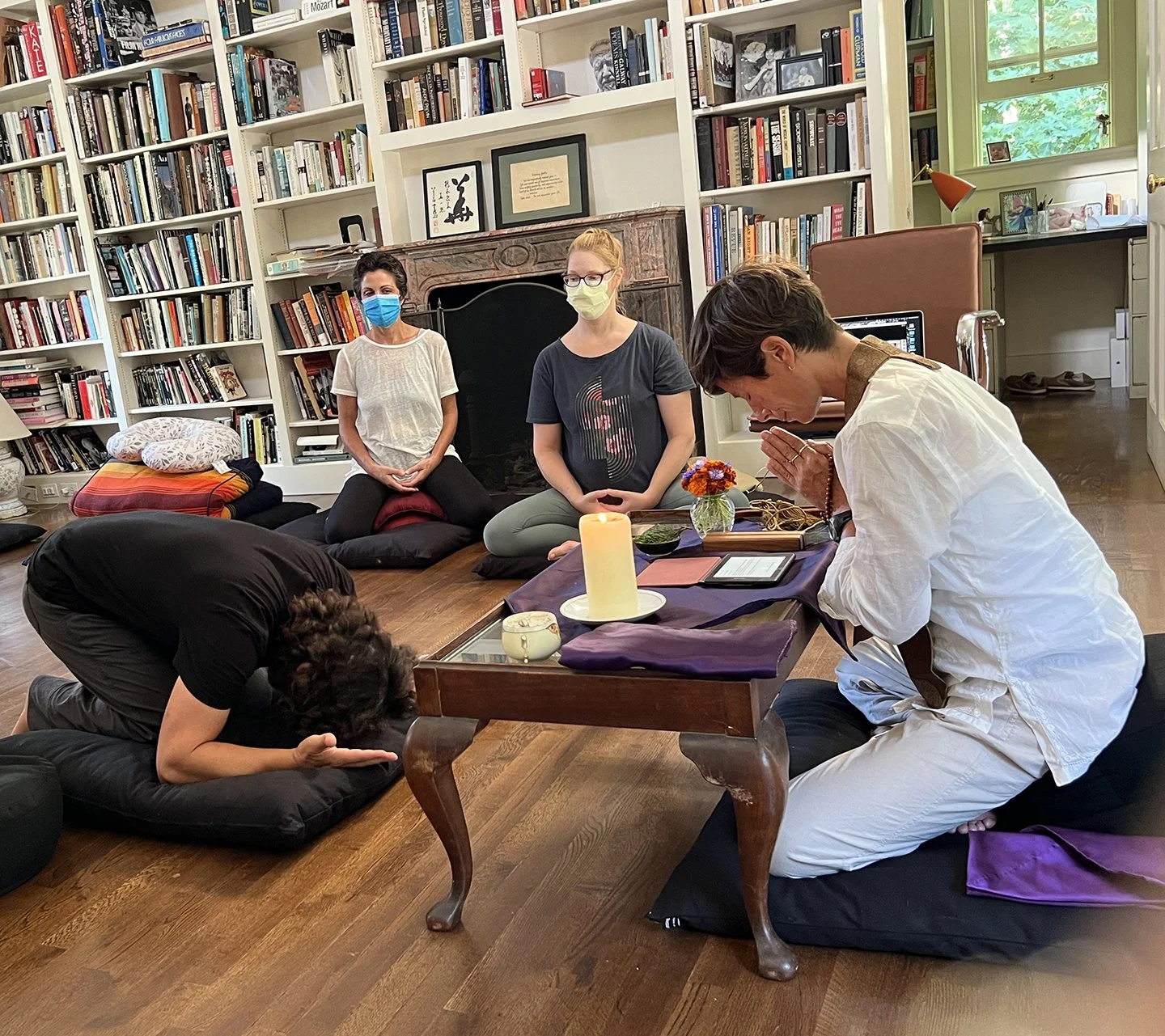
Photo by Alexandra Brown
Receiving the precepts (jukai) is a significant aspect of Zen training where a student, surrounded and supported by their teacher and sangha, commits to a life guided by the ethical teachings of Buddhism. The ceremony of jukai itself includes the taking of refuge in the Three Treasures, the Three Pure Precepts, and the Ten Grave Precepts.
Listen to and join in as Zuisei guides, and the Ocean Mind Sangha supports, Brian Ryusan Pontolilo in receiving the precepts.
This talk was given by Zuisei Goddard.
Transcript
This transcript is based on Zuisei's talk notes and may differ slightly from the final talk.
Receiving the Precepts: Jukai Ceremony
I think the first thing to say is, I think we've known each other for over ten years. I was Brian's training advisor before Brian was his teacher. And over the years, we've had a chance to just get to know each other. We have done that, but it's something very specific that happens when you're walking a path together. And that is really what we're sharing.
This is a rite of passage for you. It's another beginning. It's definitely not a culmination of the path because the path does not end. It is another beginning that we are all supporting you with and hopefully inspiring you with, inspiring you in and challenging you in more than anything, supporting you in your direction.
And so we'll begin by, if you could first do three full bows to the Buddha. So he is bowing to, and I will be speaking as we go through the ceremony. Sorry, mommy, and can you hear? Sort of, yeah, okay.
So he is bowing to, of course, Shakyamuni Buddha, the historical Buddha. He is bowing to awakened nature, and very specifically to his awakened nature. So next, you will do three bows in the direction of your parents. Of course, these vows are recognizing the blood lineage. So Brian is now taking another step to become part of this spiritual lineage. He is very much acknowledging, being grateful for unifying with his ancestors, his ancestral lineage, because his ancestors are here.
And so now he will do three vows to me. In this case, I'm the kaishi, the preceptor. And we have covered the dharan, the altar, so the altar is now set up.
Three Treasures, Atonement, Taking Refuge
So we'll begin by doing the invocation of the Three Treasures. And this really means invoking the Buddhas and Bodhisattvas, inviting them into this room. I have said in the past that this invitation is really for Mali; they don't need to be invited. This is their home; they are all here. But in inviting and invoking them, we make them conscious and we make them present for ourselves. All of the many Buddhas and Bodhisattvas who are coming for us, who will come after us, who are here witnessing and participating in this ceremony.
And I will also say, you know, for all of us, that it isn't just Brian who's taking the precepts today; we're all taking them. I would encourage you, as we go through the ceremony and he's formally taking the precepts, that you take them as well for yourself. But this is the first time that he is formally making these vows, and that is why it's an important rite of passage for himself.
Because, you know, hopefully, it is not that he is taking the precepts in order to live a moral and ethical life, in order to live a life of affirmation, of generosity, of giving, but that he is already living such a life. And this is your public acknowledgement of that. And so, for the rest of us, we think this is what we want.
So, the indication of the three treasures, I will do by myself. The first time I will chant it in Japanese, the second time in English, and then in Japanese. And this is really, as you will hear, the Buddhas, the Bodhisattvas, Dogen Zenji, Keizan Zenji, who are really mother and father of the Sōtō school, and all of our spiritual ancestors, we bring them into the realm.
"Namu," which I will say at the beginning of each phrase, means to be one with, to be one, to be. But in that invocation, that is the mind that we are invoking, the mind of unity. Everybody, please, Keshava.
Okay, next, we will do the Gatha of Atonement, and you can go up into the chicken. So the Gatha of Atonement is the Gatha of Atonement. Brian, you are taking responsibility for all of your karma, all of your harmful karma, all of your good karma as well, but you are particularly atoning for karma that has harmed others, that has harmed you.
As the verse says, it's because of our beginning list: greed, anger, and ignorance, the three poisons that are said to arise the moment there is consciousness, the moment there is awareness. But the other side of the three poisons are the three virtues: generosity, compassion, and wisdom.
And so really, at any moment when you are choosing an action, it is, you're choosing in such a way that the coin will fall on one side or the other. But first we acknowledge, we take responsibility, and we atone in body, in mouth, and in thought as well for that karma that we have created, the responsibility.
So this one we'll chant three times; we'll chant it in English. And if you could repeat after me, after each line. So I'll do one line by myself and then you all come together.
Of course, taking atonement, making atonement for karma does not erase it. It does not in any way make it as if it did not happen. But taking responsibility for it, we are in a position to then do something about it. In Shantideva, that we've been studying, he speaks of remedial action. So what actions do we take in order to shift the course of that destructive or harmful karma? And we cannot do that until we atone for it, until we truly own it. And so the act of atonement prepares us for that further action.
Next is the Asperging. And the Asperging, really, what it is, is an expression, a very concrete expression of the unity of our mind, in this case, very specifically, your mind, Brian, and my mind. And which also marks, you could say, a kind of formal entry point into the lineage of the mind.
So, the three treasures, we could say conventionally speaking—Buddha, Dharma, and Sangha—refer to Shakyamuni Buddha, the historical Buddha, without whose life, without his practice, without his realization, he would not be here. But as I said before, it is also Awakened Mind, Everywhere, Universal Mind, and beyond. It is that mind that moves toward what is good, what is wise, what is affirming, what is life-affirming.
And so, in taking refuge from the three treasures, we want to really be investigating what that is directly in our lives, for you specifically. How do you do that? What does it mean to fully throw yourself into these three treasures and to rely upon them? And so very concretely in your life, your day-to-day life, how do you take refuge in the Buddha and that awakened mind? How do you take refuge in the Dharma, in truth, in seeing things as they are, very directly?
It seems so simple. And yet, what we see in our world is our inability to see things as they are. We create reality in our own image. And so, so much of what you're vowing to do today is to work to remove the obstacles that prevent you from seeing what is there. And then going further, to bring that truth to bear in your actions, your words, and your thoughts, to create the Buddha field with all of your actions. And to choose to make that truth your path, to choose to have that be the ground upon which you are walking.
And then taking refuge in the Sangha, of course first this Sangha, the Sangha of practitioners, but also this Sangha and its multiple selves. To bring all of those selves into harmony, to understand as clearly as you can those selves, so that they are not in conflict, so that when you turn to this Sangha, what you're bringing is that harmony. Remember that Sangha is the bridge for harmony.
And really, what this means is to throw oneself wholeheartedly, unreservedly, into the three treasures. It means we drop all pretense. We become very simple, unadorned. We don't perform. We are who we are completely, without apology, without confusion, more and more as we step into our lives, as we step into who we are. And we do so in the spirit of wanting to enhance our lives and everyone's lives. Again, to not obstruct, to not be hard.
Once again, here I will chant it in Japanese. First by myself, then when I chant in English, if you can repeat each line after me. And if everybody could please chant it: I vow to take refuge in the treasures.
Three Pure Precepts
So, next is taking up the three pure precepts. And so, if you think of the precepts as a map, the three pure precepts are the cardinal directions. They are the cardinal directions. Then the ten great precepts are really the roads, the paths that you will actually walk. These directions are giving direction to your life. My teacher always used to say they are the way that a Buddha lives their life.
And so I will read the precept, I will follow the precept with a short commentary, and then I will read the Kirojokaima. This is Master Dogen's commentary on the precepts, which has been handed down in a lineage.
"I vow to not create evil." This is the root of all of our activity. Before anything else, before any thought, before any word, before any action, we vow to not create harm, to not compound the karma of suffering, to not add delusion to delusion, to not perpetuate pain, especially, most especially, when you are hurting and you want to push out to defend yourself.
This precept means renouncing our right to be right, to be first, to be safe in that protection, self-protection. It means not knowing when you step, what you step into, yet trusting that in renouncing harm, you will walk the right way. This is the abiding place of all Buddhas. This is the very source of all Buddhas. I vow to not create evil. Will you maintain this? I vow to not create evil.
"I'm about to practice good." This is the embodiment of all our activity. This is how we create a relationship with our family, at work, with friends, with strangers. This is how we wake up from the dream of delusion, the nightmare of self-isolation, of self-centeredness. This is the dharma of samyaksambodhi, great enlightenment. This is the way of all beings. I vow to practice good. Will you maintain this? I vow to practice good.
A vow to actualize good for others. This is the activation of our vows. For this, let me quote: I be a guard for those who are protectorless, a guide for those who journey on the road. I be, for those who wish to cross the water, may I be a boat, a raft, a bridge. I be an aisle for those who yearn for land, a lamp for those who long for light. For those who need a resting place, a bed. For those who need a servant, may I be their servant. I be the wishing jewel, the vase of plenty, a word of power and a supreme healing. I be the tree of miracles, and for every being, the abundant cow. Like the earth and the pervading elements, enduring as the sky itself endures, for boundless multitudes of beings, may I always be their ground and sustenance. I always meet them where they are. I always know if and when they want to be saved. I always know when this one needs to be saved.
Master Dogen says, to actualize good for others is to transcend the profane and to be beyond the holy. See what he's saying. This is to go beyond good and evil. How? How do you do that as you are acting in the world of good and evil? This is your question. This is how we liberate oneself and others. I vow to actualize good for others. I vow to actualize good for others.
Ten Grave Precepts
Next are the ten grave precepts. And so, as I said, these are really the roads. In fact, some of them are wide as highways; they will be obvious how to proceed. Some of them, you will have to bushwhack your way through the bushes, through the woods. Your aspiration, your vow, is to find a way, when there is no way, where there seems to be no way. You will find it. And the ten great precepts show you how, in a very indirect way. So you have to meet them.
The first grave precept is to affirm life. I vow to affirm life. I will not kill. This includes all the ways we take life, that we rob a person of a life. The literal way that we kill, which is doubly harmful because it robs a person from the opportunity to awaken. But also all the ways in which we might degrade ourselves or others, with regard, erase, cut off parts of ourselves, parts of those many selves, the way our choices could be killing somebody else on the other side of the planet. And so there's the literal way of responding, of taking in and responding to this precept, and then there's the path that will be revealed to you; you can measure it with your understanding and with your practice, your realization, and that is what you're never done, because it will always, always be more to see. Life is non-killing. The seed of Buddha grows continuously. Maintain the wisdom life of Buddha and do not kill life. I vow to affirm life. I will not kill. We will maintain this. I vow to affirm life. I will not kill.
The second grave precept is to be giving. I vow to be giving. I will not steal. This precept encourages us, of course, to refrain from taking what is not ours. But it also is encouraging us to extend the boundaries of the self, to give of our time, to give our attention. Knowing that when we do so, we're not just benefiting others, we're benefiting self because self and other are not two, as another precept says. And with all of these precepts, it's not a matter of sacrificing. It's not a matter of renouncing some part of yourself so that you can do the right thing, the noble thing. You know that is not the way. It is a matter of aligning yourself with what is already true. And sometimes that means removing some obstacles that might be in the way. But never think of this as self-sacrifice, because then we cannot last. And whenever you feel the impulse to involute, open, remember, open. Do not constrain what is by nature, when it is. The mind and externals are just us. The gate of liberation is always open. I vow to be giving. I will not steal. Will you maintain this? I vow to be giving. I will not steal.
The third grave precept is to honor the body. I vow to honor the body. I will not misuse sexuality. To misuse sexuality is to engage in power play, to engage in harmful desire, or to engage in abuse. Of the three poisons, desire is the strongest. Of desires, lust is the most compelling and the most damaging. It is not by itself harmful. But when it is self-centered, self-serving, its potential to harm is for you. And so once again, more than renouncing desire, this precept is helping us to have a wider view of our actions, to understand what in a moment we may choose to ignore so that we don't live in regret. And this is one of those precepts that it's good to work with when you're calm, when you're steady, when you're grounded, so that you can make use of it when you're not. It asks us to fully honor this body, this body and this body, because they are not two.
The fourth grave precept is to manifest truth. I vow to manifest truth. I will not lie. We lie to protect ourselves. But when we see that the self is an illusion, then what is there to protect? When we're not prey to the eight worldly whims—praise and blame, success and failure, pleasure and pain—then we are completely open, exposed, vulnerable. There is no need to cover up, no need to bend the truth. Lying harms others, but it's probably the most corrosive agent in our own being. Manifesting truth is really walking on the ground of reality. The Dharma wheel unceasingly turns, and there is neither excess nor lack. Sweet Do permeates the universe. Gain the essence and realize the truth. I vow to manifest truth. I will not lie. We maintain this. I vow to manifest truth. I will not lie.
The fifth grave precept is to perceive clearly. I vow to perceive clearly. I will not cloud the mind. With the obvious ways of clouding the mind—drugs, alcohol, sex, television, our phones—not with fantasy, not with stories about ourselves or others, not with stories about the world. At heart, this precept is choosing to see what is there, to be in and of our lives. When we do that willingly, the path opens. Even when we go off the path, when we lose our way, what we return to is the vow to perceive clearly, the vow to manifest truth. You don’t flunk when you fail to uphold the precept; it simply shows there is still more to see, more to live into. Always, when you notice the gap between what you wanted to do and what you actually did, notice that gap and let it hurt. Let it hurt, because that will bring you back. Remember that our mind is always naturally bright, cognizant, and tender. It has never been defiled. It is indeed the great clarity. I vow to perceive clearly. I will not cloud the mind. We maintain this. I vow to perceive clearly. I will not cloud the mind.
The sixth grave precept is to see the perfection. I vow to see the perfection. I will not speak of others' errors and faults. Many Buddhist teachings emphasize speech, right speech. In the Mahayana Sutras, the Buddha's last words were to refrain from idle talk, because it is so easy to cause harm with our words. Most of the time, it feels like, who am I really hurting? It's just a little, I'm just telling the truth about someone. This precept is not about calling out harm, which sometimes needs to be done. It is about self-serving speech. Seeing the perfection means seeing the wholeness. It doesn’t mean that people or situations are flawless; it means they are whole, complete. Seeing ourselves as such, seeing the world as such, we realize how foolish, and frankly, what a waste of time it is to criticize. With this precept, we strive to speak peace, to be peace with our words. In the midst of the Buddha Dharma, we are the same way. Do not speak of others' errors and faults. I vow to see the perfection. I will not speak of others' errors and faults. I vow to see the perfection. I will not speak of others' errors and faults.
The greatest challenge is to know when to bend, when to flow, and when to stand.
The seventh grave precept is to realize self and others as one. I vow to realize self and others as one. I will not elevate the self and blame others. While the previous precept was about not criticizing, this precept is about not isolating, not elevating oneself while putting down others. If you can answer this question, then there is no need to trace or blame. This precept asks us to stand on our own two feet, covering completely the ground on which we stand. Go beyond winning and losing, beyond being first and last, beyond being the best practitioner, the most studious, the hardest sitter. All of that is irrelevant. Buddhas and ancestors realize absolute emptiness and the great earth. When the great body is manifested, there is neither inside nor outside. When the Dharma body is manifested, there is not even a single square inch of ground upon which to stand. I vow to realize self and others as one. I will not elevate the self and blame others. I vow to realize self and others as one. I will not elevate the self and blame others.
The eighth grave precept is to give generously. I vow to give generously. I will not be withholding. The second great precept asked us not to take; this one asks us to open and to give generously, to not limit ourselves by this body, this mind. Often, those who have the most give the least. This precept asks us to practice abundance, to rest in generosity, and to trust that everything we need will come to us. One phrase, one verse, 10,000 forms, 100 grasses, one Dharma, one realization—all Buddhas, all ancestors. Since the beginning, there never has been anything to withhold. I vow to give generously. I will not be withholding. I will maintain this. I vow to give generously. I will not be withholding.
The ninth grave precept is to actualize harmony. I vow to actualize harmony. I will not be angry. Anger is often self-protection. Shantideva says a moment, an instant of anger can destroy kalpas of practice, realization, harmony, and love. Stripped of self-centeredness, anger shows care and love. Imbued with self, anger destroys. Anger is the self not wanting to heal itself, not tolerating itself. The precept requires enormous strength, determination, and courage. Stay present, do not project, lash out. Self-liberate anger and use its energy to liberate others. It is not regressing or advancing, not real, not unreal. There is an illuminated cloud ocean, an ornamented cloud ocean. I vow to actualize harmony. I will not be angry. We maintain this. I vow to actualize harmony. I will not be angry.
The tenth grave precept is to experience the intimacy of things. We started at the beginning saying, they cannot be defiled. This precept is really saying it all: don't just talk about it, live it. Don’t just study it, live it. Get close. It’s not even the most wondrous philosophical, religious, or scientific views that help liberate us. But if we practice, realize, and actualize in the ever-spinning spiral of life, we have a chance to be intimate. A chance to embody, to actualize what is already true. Living the Dharma with the whole body and mind is the heart of wisdom and compassion. All virtues return to the ocean of reality. Do not comment on them—practice them, realize them, actualize them. I vow to experience the intimacy of things. I will not defile the three treasures. Will you maintain this? I vow to experience the intimacy of things. I will not defile the three treasures.
Dharma Name and Significance
These sixteen precepts—the three treasures, the three pure precepts, and the ten great precepts—are handed down by Shakyamuni Buddha, generation after generation, down to me. I now give them to you. Will you maintain them well? Will you maintain them well? Will you really maintain them well? I will. And if you don’t—let’s go.
On this July 23rd, 2022, Brian Pontolilo has received the sixteen precepts of the Bilawe, Aroksu, and is being given the Dharamane, Rusa, Zuisei precept. Please, Kasia.
So now, Brian will do Junda, passing in front of each of your seats in a standing gassho. You can do a seated bow to acknowledge him joining the lineage of Buddhist ancestors and offering him water for wash.
Let me say a little bit about how I have been finding my own way to teaching. There are certain things I’ve done slightly differently. I did not give Brian a certificate when he became a student; instead, I gave him a mala. All my students have received a mala from me, because I wanted something tangible. Papers get lost, people move—things like that. The date of the ceremony is in your raku su, so we will not forget.
Brian has received a raku su. He did not sew this himself, which is often done, but our setup is not conducive for that—it’s a complicated task, as Adam can attest. I wanted the focus to be on the precepts, on what he is now living day to day. It was made for him, just as my teacher’s raku su was made. Remember, it is a miniature version of a Buddha’s robe, worn over one shoulder. What you are wearing now is the Buddha’s robe; you will have it whenever you sit, whenever you need to remind yourself of standing on that ground.
Traditionally, the lineage chart includes only male ancestors, which for some time felt incomplete. When I received transmission, my chart included both men and women, copied by hand. I didn’t want to use the traditional format and include only male teachers. I am still envisioning how to present a lineage that honors both, and I will give that to you and your successors once it feels complete.
Your dharmane, ru sun: “ru” means flow, the flowing of someone who does not get easily stuck, who does not need to stake on the ground because they see the ground everywhere. Flowing water is soft, like milk, yet strong enough to hold up a ship. “Sun” means mountain: everything solid, dependable, the earth beneath the water, the ground you walk on and the ground you have yet to discover. Sun is not easily swayed, but it is not immovable. The greatest challenge is to know when to bend, when to flow, and when to stand. You will know, because you already know, and because you have help. You can call on that help now.
This is a little like a hatching: the hen pecks from the outside, the chick pecks from the inside. When the pecking is in harmony, when the time is right, the shell breaks, and the chick comes out. Conventionally, moral and ethical teachings are meant to keep us in check, to live in harmony, but Buddhism actively helps us awaken. Even when we fail to fulfill a precept, that moment becomes fodder for awakening.
So, please never think of these precepts as rules, but as teachings. Think of them as the fabric of your life, because that is what they are. The more you know that and integrate it, the more it becomes a matter of following the inherent pattern of your own wisdom.
Receiving the Precepts: Jukai Ceremony, a dharma talk by Zen Buddhist teacher Zuisei Goddard. Audio podcast, video, and transcript available.
Explore further
01 : Precepts: Taking Refuge with Vanessa Zuisei Goddard
02 : Knowing How to Be Satisfied with Vanessa Zuisei Goddard
03 : On Jarvis Masters: Living the Buddhist Precepts with Vanessa Zuisei Goddard