
Fusatsu: The Lineage of the Ancestors
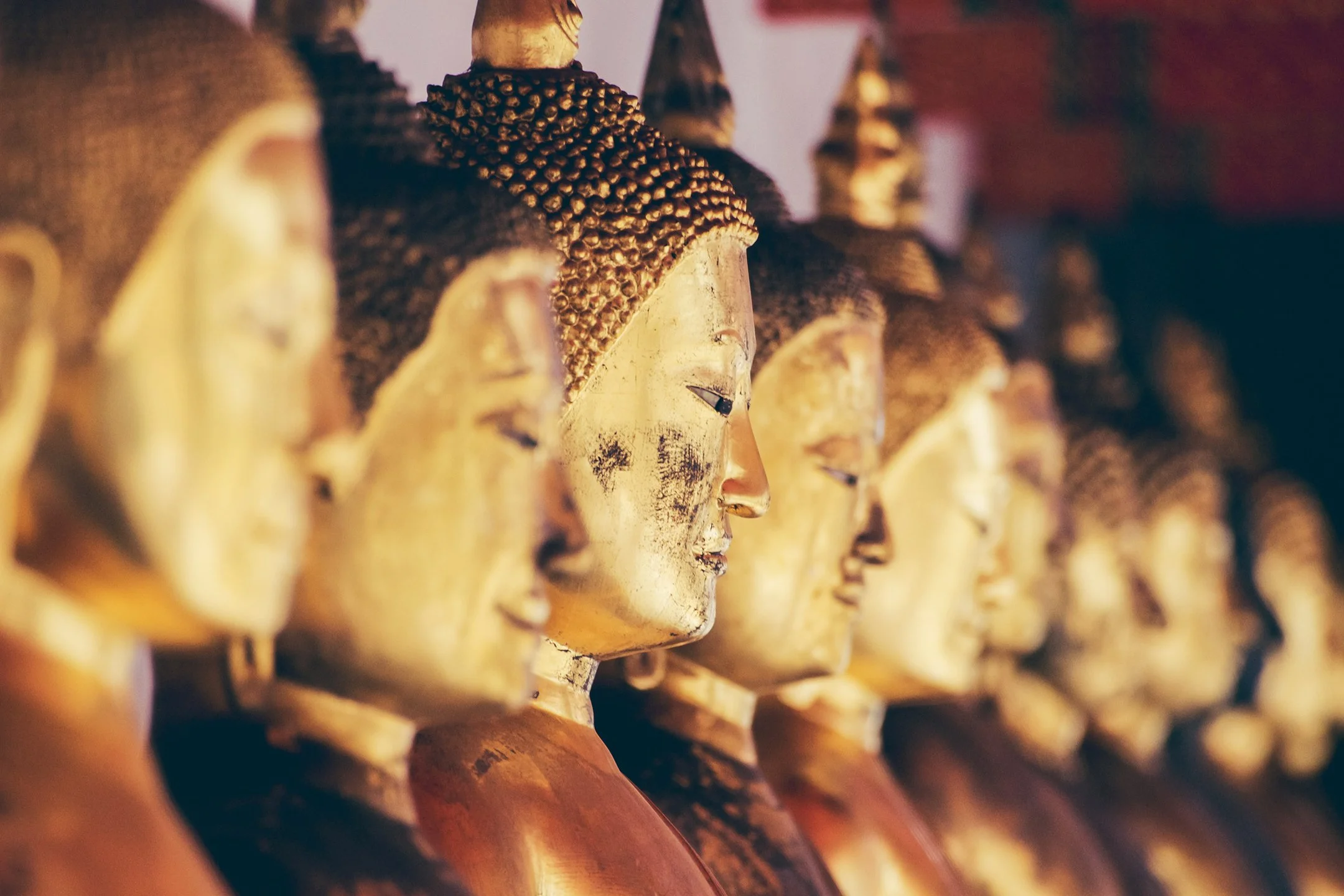
Photo by Alexandre Chambon
To practice Zen means not just to turn inward and seek personal liberation but to step into the bloodline of the ancestors, to realize—and live from—the wisdom and compassion that has been transmitted mind to mind from Shakyamuni Buddha down to us.
In this talk, given during an OMS fusatsu (renewal of vows ceremony), Zuisei looks at what it means to take our place in the lineage of enlightened beings. It is not an abstract exercise in paying tribute to our spiritual forebears or trying to emulate them, but a vow to honor them by realizing that we are perfect and complete exactly as we are. In being ourselves wholeheartedly, we come to see what has always been true, that we are one with the awakened teachers who came before us, and with all life.
This fusatsu talk, Blood Lineage, was given by Zuisei Goddard. Scroll below for video, audio, and transcript.
Transcript
This transcript is based on Zuisei's talk notes and may differ from the final talk.
The Lineage of the Ancestors
Fusatusu Talk
Today we are doing a Fusatsu or Renewal Vows Ceremony in preparation for the jukai ceremony we will do tomorrow. Four of you are formally stepping into the stream that is the bloodline of the ancestors—the lineage that has been handed down, generation after generation, since the time of the Buddha. But actually, all of us here have also stepped into that stream, have benefited and continue to benefit from the wisdom and compassion of all the enlightened teachers and students who’ve made the dharma their path, who have decided to stop colluding in samsara, and are instead doing the work to be and stay awake.
You could say that we are here because we recognize that ignorance is not bliss. That ignorance is simply ignorance, and that it’s not how we want to live. We enter this dharma stream, this current of wisdom and beneficial activity, so that we can offer something good and lasting to the world. So we can live and die at peace with ourselves, knowing that we’ve lived aligned with the truth, the law of how things are. So that, at the moment of our death, we’ll have no regrets. But also so we can make the most of this gift that is a human life as we’re living it.
We enter this dharma stream so that we can offer something good and lasting to the world.
This morning I’d like to say a little bit about the blood lineage. Neither the male nor the female lineage is a strictly historical record. It’s been reconstructed, as well as that’s possible to do, given the thousands of years that have gone by since the Buddha was alive, to represent an unbroken line of transmission through the generations, from the beginning of Buddhism in India, its movement to China, and in our case, Japan and the United States—with a short detour at the end through Mexico and Panama.
The men’s lineage is taken to be somewhat historical once it gets to China, where records of the transmission between teacher and student began to be recorded, and where it was possible to ascertain that the people involved were in effect historical figures who lived and died and taught and kept the dharma alive.
Our kechimyaku or lineage chart is specific to our lineage, so it looks different for someone in the Suzuki Roshi lineage, or the Katagiri Roshi lineage, or the Thich Nhat Hanh or Master Sheng Yen lineages, not to mention the Tibetan lineages. But at least in Zen, all of the charts end with the current teacher’s name, and below it, a blank space where the teacher writes the name of the student taking the precepts, writing them into this unbroken stream.
The women’s lineage does not represent a historical line from teacher to student because, sadly, records were not kept of many of the female enlightened teachers of the time. Instead, various Zen lineages have created their own versions of this circle of dharma—since the women’s lineage tends to be represented with a circle instead of a line—and we have done the same, connecting the two lineages through the common source that is our first teacher, Shakyamuni Buddha. Which means you’re getting double the power, all those enlightened practitioners giving something so you can be here today.
The Lineage of Awakening Through Time
As you heard in one of our chants this morning, there is also a bit of history before the Buddha Shakyamuni. Six other buddhas are named, and together with Shakyamuni, Siddartha Gautama, they are called the Past Seven Buddhas. Using first their Japanese, then their Pali names, they are: Bibashi, Shiki, Bishafu, Kuruson, Kunagomuni, Kasho, and Shakyamuni. (Vipassi, Sikhi, Vessabhu, Kakusandha, Konagamana, Kassapa, and Shakyamuni.) The Buddha Kassapa shares the name of the Buddha’s student, Mahakashyapa, but is not the same being. These are named in a sutta called the Mahapadanasutta that tells us who they were, what family they belonged to, how many disciples they taught, who their parents and their attendants were, as well as a detailed biography for each one.
The Buddha, speaking to his disciples about past lives, describes the first Buddha’s birth, Vipassi, which is almost identical to Shakyamuni’s birth, and just as auspicious. His mother gives birth standing up, and Vipassi is born fully formed, completely clean, facing north.e takes seven steps, lifts one hand to the sky, points with the other to the earth, and says, “Between heaven and earth, I alone am the honored one,” and the galaxy shakes and rocks and trembles. “This is normal for one intent on awakening who takes human birth,” the Buddha says. This is normal. He has the full thirty-two marks of a Buddha, which Shakyamuni lists in detail, and as happened with him, at his birth a wise man says to his father, a king, that his son will be a great ruler: either a wheel-turning king or an awakened Buddha. In short, his story is just like Shakyamuni’s story, and I’m sure if there was another Buddha before him, or a whole host of Buddhas, Vipassi would tell their story exactly in this way.
When the Buddha is telling this story to his disciples, he says that a host of deities came and told him all this, and they told him the same about the other five Buddhas, and then repeated the story with him, Shakyamuni, as the protagonist. The Buddha tells his students—and us—his own origin myth, and replicates it stretching back into the past for countless generations. Why? What’s the purpose? It’s one way to establish authority, of course. This has been going on since time immemorial. This isn’t something I made up—it’s something I realized, I discovered for myself. But it’s also a way to establish the all-pervasive nature of awakening. That’s why my first teacher, Daido Roshi, could claim that if Buddhism were to disappear from the world for thousands of years, and one day one person realized what Shakyamuni Buddha realized, in that moment that bloodline would be reestablished, and it’d go on, unbroken.
Discovering the Abundance That Has Always Been Here
Realization is not dependent on time or place. It’s not dependent on capacity or intelligence. It’s not limited by gender or cast or age or race or ability or religion even. Awakening is not a Buddhist event. Just as putting on glasses and being able to see isn’t limited by who you are or what you’ve achieved. Regardless of who you are, you put on glasses and you can see more clearly.
Imagine this stream not as a river but as an ocean, then, and see that you are right in the middle of it so that wherever you turn, there’s water as far as your eye can see. At one point you think to yourself, “God, I’m so thirsty!” And one day, although you’ve been floating in this water for months and years, one day you think, “What if I try it? What if it’s the kind of water I can drink?” So you reach out your hand, and you scoop a small handful up, and you bring it to your lips, and when you swallow, lo and behold! You can drink it. Not only can you drink it, it’s the clearest, coolest, freshest water you’ve ever tasted. That’s when you realize you’ll never, ever, be thirsty again. You’d have to try, really try to avoid the water, and even then you couldn’t do it. You could refuse to drink, for a while, but why in the world do such a thing when there’s so much life there, and all of it for the taking? All of it enough and more than enough, for you and anyone else you now find in the water with you.
You were so busy trying to survive, just staying afloat, that you hadn’t noticed all those other beings floating with you. But now you see them and you gesture to the water and let them know it’s okay to drink, it’s good to drink, it’s excellent to drink. And so they too reach down their hands and scoop up a handful and the look of relief on their faces, their look of happiness, reflects exactly how you feel.
All that struggling, all that fighting, all that rushing and grabbing and hiding—completely unnecessary. But you know that now, and it’s okay. You had to go there to get here, you had to hear the stories over and over again, you had to start over a million times, just like these buddhas. But you’re here now and now you know there’s nothing you don’t have, there’s nothing missing because the thing you’re floating in and the thing you are, are the same thing.
Explore further
01 : Fusatsu: on Karma and Choice with Zuisei Goddard
02 : The Practice of Togetherness with Zuisei Goddard
03 : Ancestors with Zuisei Goddard and Hojin Sensei
The Lineage of the Ancestors, a fusatsu talk by Zen Buddhist teacher Zuisei Goddard. Video, audio, and transcript available.