
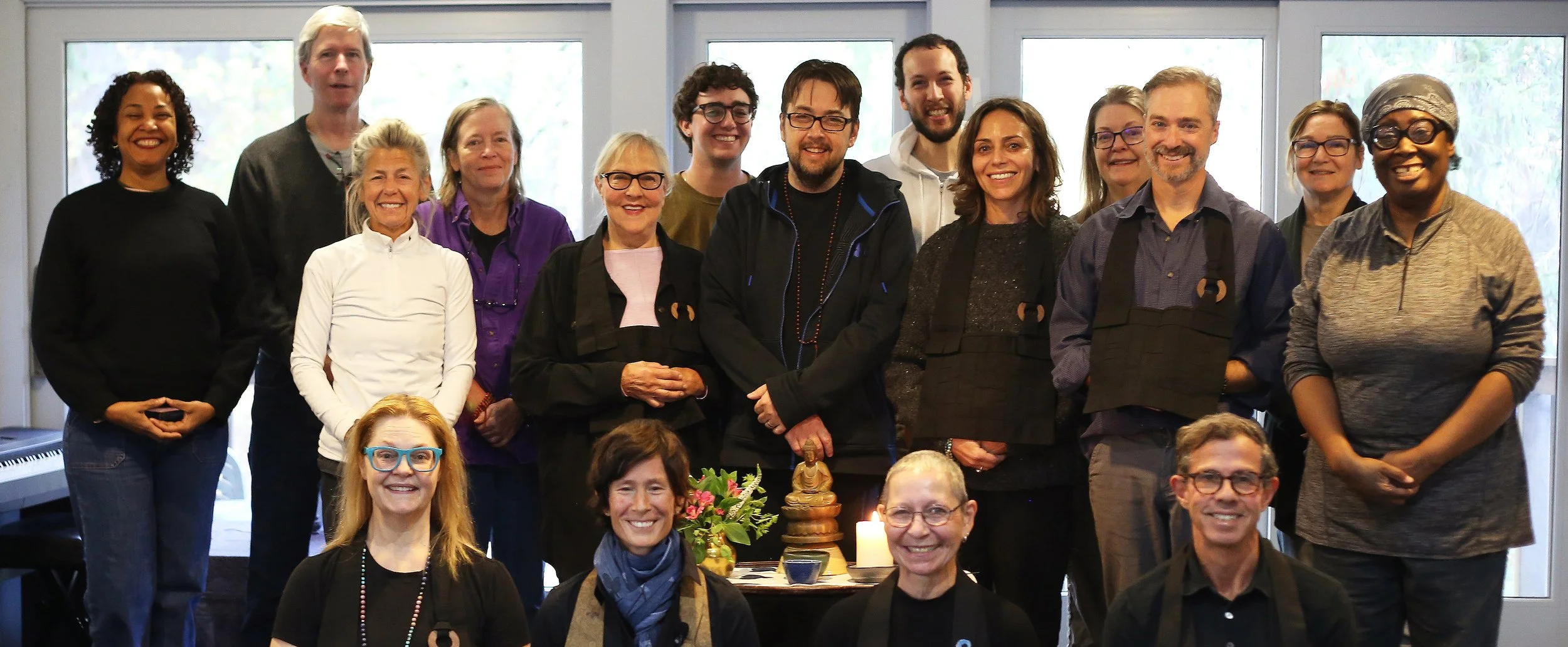
What is Lay Zen Training?
If you’re considering training at OMS, or have questions about the process, please visit here.
Today, Buddhist lay practice takes many forms, but as is true of the monastic path, lay practice is supported by personal vows, a commitment to the sangha and teacher, and ongoing study. A lay practitioner (Skt. upāsaka, “one who sits near” [the teacher]), is a life-long student whose commitment to practice and liberation is rooted in their aspiration and whose vow is expressed in the midst of their everyday lives.
Homedwellers through the Ages

Yüeh-shan, The Three P’angs, 1280-1368
Lay practitioners and teachers have a long and prominent history in Mahayana Buddhism. There’s Vimalakirti of the Vimalakirti Sutra, the well-known Indian lay practitioner who was said to be as enlightened as the Buddha. There are Layman Pang, his wife, and their daughter Pang Ling Zao, who were all considered to be enlightened homedwellers in 8th century China. And there are the countless upāsaka through the ages—some of them anonymous—who’ve taken refuge in the Three Treasures of Buddha, Dharma, and Sangha.
Continuing this time-honored tradition, students at OMS choose from one of two paths of study (practicing and formal students), developing a close relationship to themselves, the dharma, and their teacher.
Zen Training: The Teacher
Student-Teacher Relationship

Photo by Alexandra Komyo Brown
Formalizing the student-teacher relationship is an important step in Zen training, and a central of the Buddhist path. based on an intimate and mutual commitment between teacher and student, it’s nurtured through frequent interaction in both group and individual settings (see daisan below).
To learn more about the uniqueness of this relationship and the trust and love that it’s based on, listen to the this talk by our Guiding Teacher Zuisei.

Daisan: Private Teaching
Zen students meet regularly with the teacher in brief private sessions called daisan in which the student works to develop their practice with the guidance of the teacher. Mindfulness of the breath, koan study, shikantaza (“just sitting”) practice, and loving-kindness meditation are just a few of the formal practices that a student engages with the teacher, always with an eye to their relevance for their everyday life.
Guiding Teacher Zuisei Goddard received dharma transmission from Geoffrey Shugen Arnold Roshi, and is now a lay teacher offering private teaching and formal Zen training to students of all levels of experience. To learn more about the paths of practice available at OMS, visit here.
Rites of Passage
Tangaryo
Tangaryo means the “room where you stay until the morning” (tanga: “staying until the morning,” and ryo: room). It’s a term that refers to a Chan tradition where prospective monastics showed their aspiration and sincerity by sitting in zazen—sometimes for days—outside a monastery’s gate. In its current form, sitting tangaryo gives the student the opportunity to reflect upon their commitment to practice, the teacher, and the sangha, and to formally ask the teacher for the teachings, which in turn gives the teacher permission to teach them. Afterward, the sangha welcomes formal students in a Student Entering Ceremony.
To learn more about the spirit of Tangaryo and the determination, resilience, and aspiration needed on the path, watch Zuisei’s dharma talk, Possibility.
Celebrating Jukai
When a formal student has spent some time in practice and Zen training, they may petition to receive the Buddhist precepts in a ceremony called Jukai. Jukai marks the student’s commitment to the Buddhist path and to living a moral and ethical life whose focus is the care of all beings and our planet. The ceremony includes the taking of refuge in the Three Treasures, the Three Pure Precepts, and the Ten Grave Precepts.
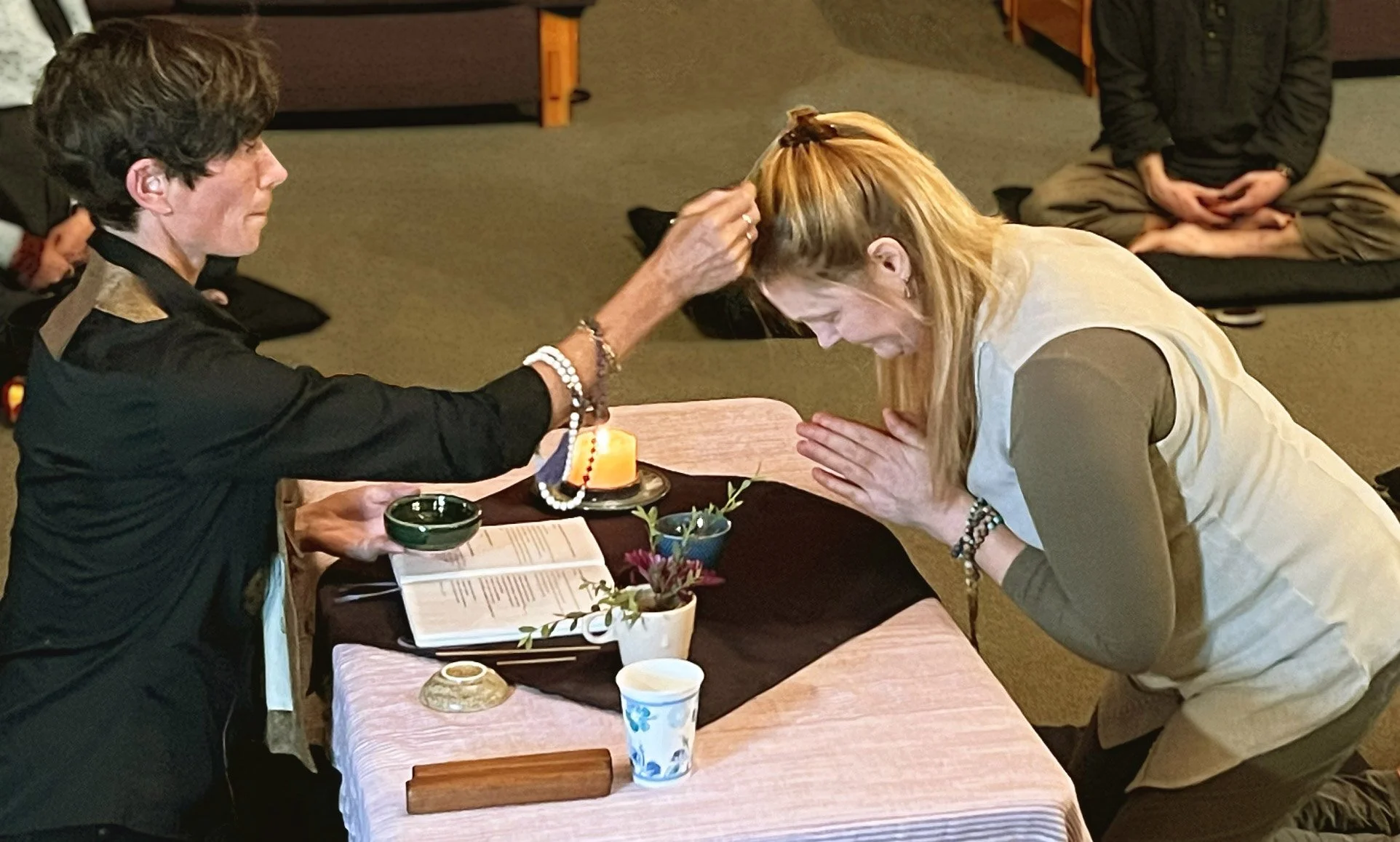
Listen to Ocean Mind Sangha’s first Jukai ceremony, where Brian Ryusan Pontolilo received the Buddhist precepts.
Shuso Training
Originating in the Song dynasty Chinese monasteries, the role of the shuso (首座) literally referred to the “head seat,” goes to a junior monk whose training shows a certain level of maturity and development. In OMS, lay students who have progressed in their practice may be chosen to serve as a shuso or chief disciple for two one-month angos, at the end of which they’ll make their transition to senior student. For more information on ango, visit here.
The real heroism is showing up, again and again for your life; to decide to be in your life in this and every moment.
— Zuisei
Spring ango closes with a Dharma Encounter (an impromptu question and answer session on a Buddhist topic between the teacher and the sangha), and the fall ango concludes with a Shuso Hossen Ceremony in which the shuso is installed as a senior student.
If you are considering training at Ocean Mind Sangha with Guiding Teacher Zuisei Goddard, visit here for details. Ocean Mind Sangha meets regularly online, with the opportunity to practice together twice a year in person.


