May 2026
What is Emptiness in Buddhism? Buddhist Study with Zuisei Goddard
What Good Is Emptiness?
Understanding Shunyata and Its Role in Our Lives
This class has ended.
Shunyata or emptiness describes all phenomena as being empty of self, or having no intrinsic nature—no inherent qualities, independent existence, or distinguishing characteristics. This can be tricky to understand compared to the vibrant experience of being alive and the rich palette of differences that makes us human.
The course opens with an optional hour of zazen (silent meditation) and daisan (short private teaching with Zuisei). Everyone is encouraged to join us for zazen, but if you just want to attend the class, you’re welcome to do that.
Banner photo by Alexandr Marynkin
A longer description of shunyata or emptiness is available below. For teachings by Zuisei on emptiness visit Zuisei's short article "Emptiness Brimming with Love," and the dharma talk, "The Heart Sutra: Emptiness Brimming with Love."
Emptiness in Zen Buddhism
What is the difference between
Emptiness and Nothingness in Buddhism?
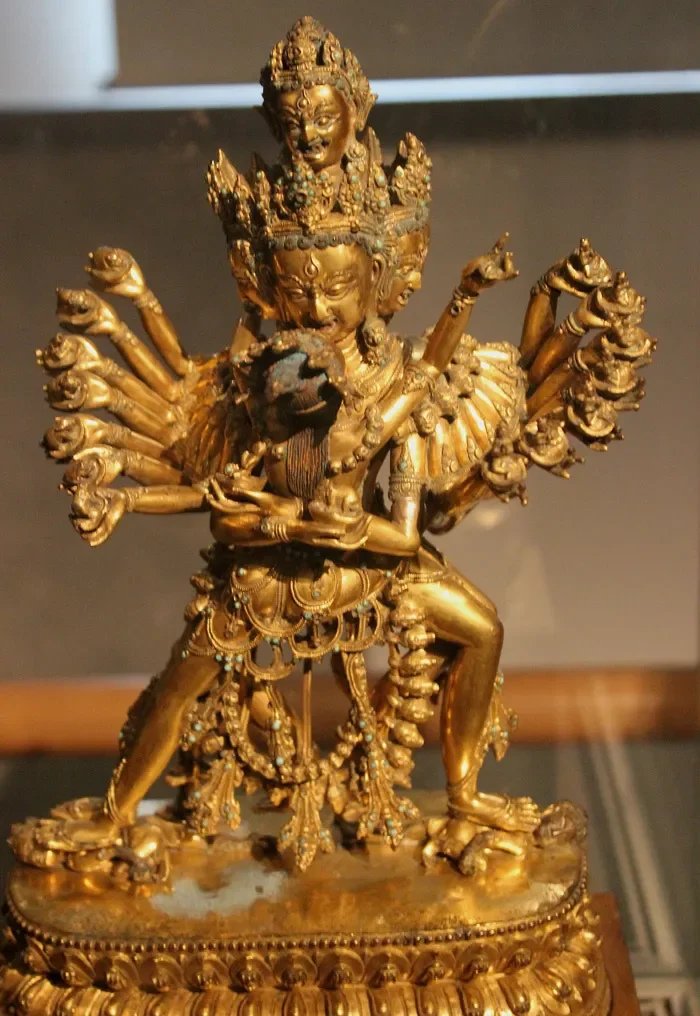
Buddhist deities Nairatmya and Hevajra. Nairatmya is the goddess of emptiness, and of anātman realization.
The Buddhist term emptiness or shunyata, can appear somewhat abstract at first glance, alien to our everyday experience. Is this emptiness some kind of void, some kind of absence or lack, a type of nothingness? Traditionally, shunyata is known as “empty of self nature,”¹ but emptiness is far from an experience of lack or missing something. Instead, it is what makes possible the rich and vibrant experience of being alive. It’s because of emptiness that things can shift and grow, and that the differences we see all around us take on such powerful significance. Think of emptiness as the ground, and things as all the many trees and shrubs and flowers that grow from it.
Shunyata is known as “empty of self nature” because of our attachment to the belief in a permanent, separate self. This attachment is a powerful delusion, it is the root of our ignorance.² It prevents us from seeing things as they really are—completely interconnected and unified. When we don’t see this clearly, we begin to identify ourselves and each other with our accomplishments, our possessions, our job or status, our looks. . .
Seeing emptiness, on the other hand, frees us of from the experience of this delusion. We realize that we are not that embarrassing moment or that promotion, we are not a personality, an emotion, or a role. We are not the fight we had last night or the trophy from years ago. We are not self-made or alone. We are not what we do or fail to do. We are not made of finite, hardened categories, and our value is not tied to any of these. We are, though, here and now—that’s undeniable.
What is Empty? The Flow of Interbeing
What are we, then? What is this emptiness if not defined by lack? The Chinese character for shunyata is also one of the characters for sky. Early Chinese Buddhists likened emptiness to the sky above, an infinite expanse. That expanse is within and without, it is all phenomena, all beings and all things. Look closely at anyone or anything and you will see the parts that make them up. But study those parts and they too will come apart into more pieces, until you see millions of the smallest fractions of molecules and atoms and those are mostly made of space. This applies to any of us too. We’re each mostly empty space.
If you wish to make an apple pie from scratch, you must first invent the universe.
—Carl Sagan
Or, we could also say, we’re made of everything. As Zen Master Thich Nhat Hanh says, a poet can look closely at a piece of paper and see the cloud, the rain, and the sunshine that helped grow the tree that made the paper. They can see everyone who had a hand in bringing that paper to life, and everyone and everything that supported them—their ancestors and their children, the food that nourished them, the air they breathed, the plants that photosynthesized the air, and so on. That living, breathing mosaic of life across space and time is contained in that one piece of paper, or in any other thing that we can lay our hands on.
As Carl Sagan famously said, “If you wish to make an apple pie from scratch, you must first invent the universe.” The entire universe is needed to make, not even a whole pie, but a single grain of flour.
Nothing stands alone or is static, everything flows, changing from moment to moment, connected, and empty of a permanent, separate self. We are this infinite flow. We are the expanse brimming with possibility.
An Invitation
Saturday, May 30
Join Ocean Mind Sangha and Guiding Teacher Zuisei Goddard as Zuisei leads a live online class and Q&A on the teaching and practice of Emptiness. The class opens with an optional hour of zazen and the opportunity for daisan (face-to-face teaching) with Zuisei.
Explore this essential teaching on May 30, and consider taking a look at these additional resources on the traditional Buddhist teachings of emptiness and its relationship to daily life: Zuisei's short article "Emptiness Brimming with Love," and the dharma talk, "The Heart Sutra: Emptiness Brimming with Love."
Other Resources
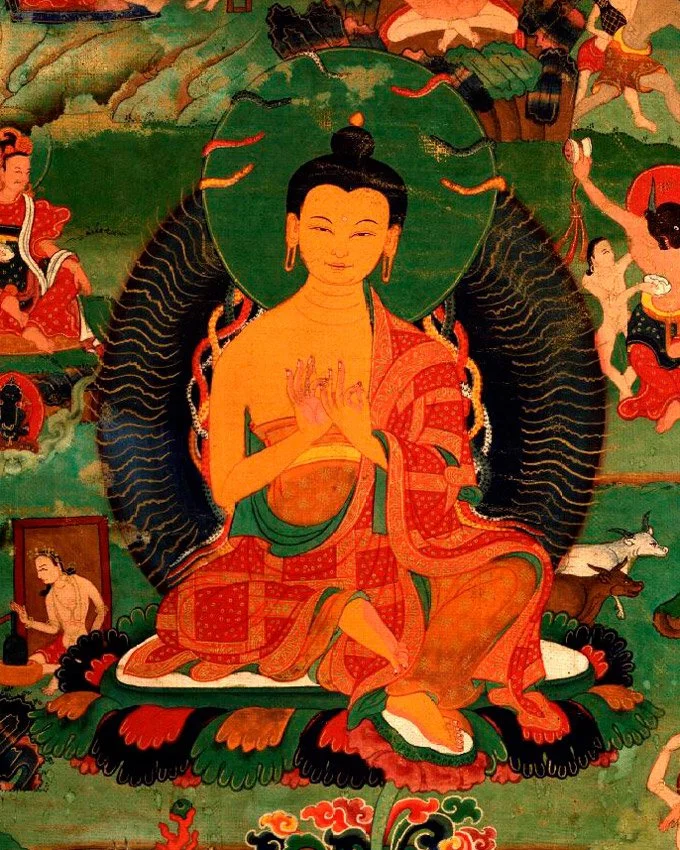
Painting of Nāgārjuna (18th century)
Buddhist teachers have seen emptiness as the core of the Buddhist path—an essential step on the way to liberation—for millennia. Many foundational texts point to emptiness in different contexts, and each offers a unique path into understanding shunyata.
Dependent Origination
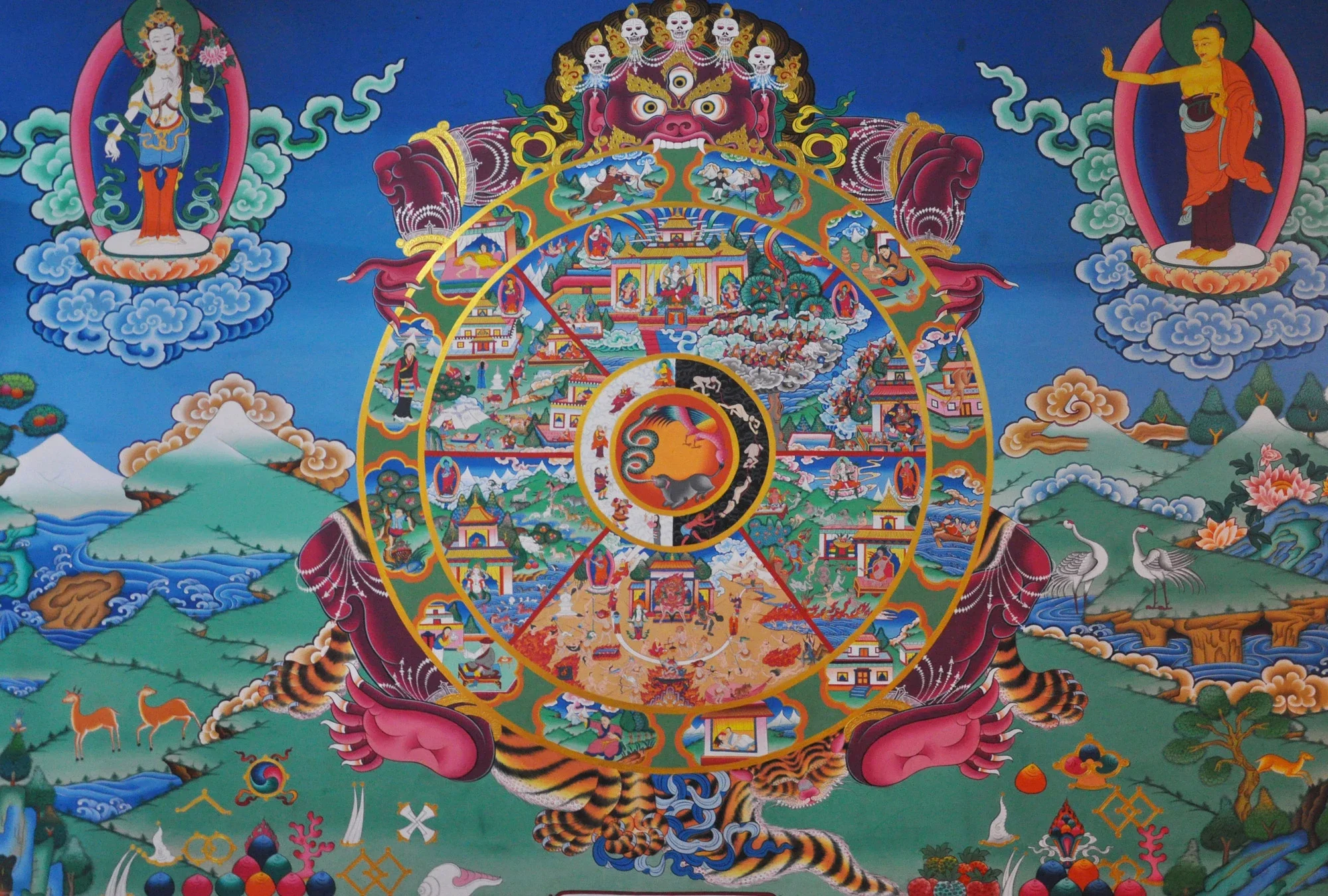
Wheel of Life, Bhavachakra Image by Prof Ranga Sai, CC BY-SA 4.0
The traditional teaching of Dependent Origination or Dependent Arising explains how all phenomena—from a hurricane to a passing thought—come to be, how they change, and how they pass.³ It makes clear in detail how everything that comes to be was caused by something else and then needs the correct conditions to live or unfold. Everything arises from an infinite and always changing, interdependent network of these causes and conditions—nothing, absolutely nothing, exists by itself.
The Heart Sutra
Often considered the widest known and most recited Mahayana Buddhist scripture, the Heart Sutra⁴ points to emptiness directly. The teaching opens with the Bodhisattva Avalokiteshvara’s epiphany:
Avalokiteshvara Bodhisattva, doing deep Prajna Paramita,
clearly saw emptiness of all the five conditions,
thus completely relieving misfortune and pain.
Oh Shariputra, form is no other than emptiness,
emptiness no other than form.
Form is exactly emptiness, emptiness exactly form.
Avalokiteshvara continues to expound on shunyata for the totality of this sutra, imploring and exalting its understanding.
No Water, No Moon
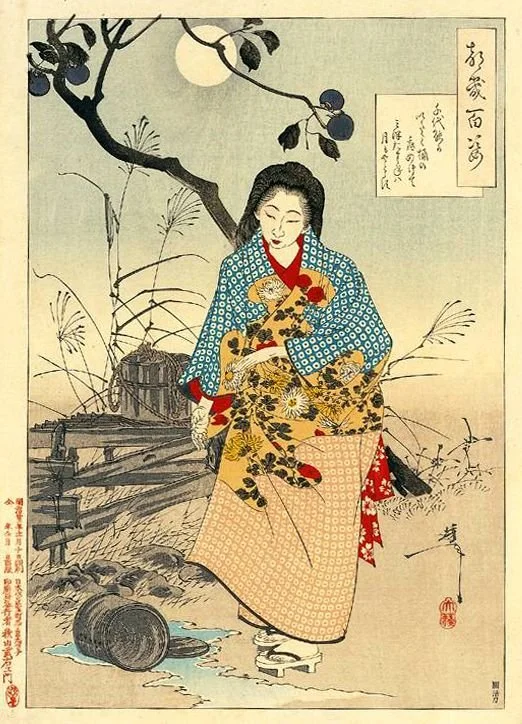
Lady Chiyo (Nyodai) and the Broken Water Bucket
Print by Tsukioka Yoshitoshi
No Water, No Moon
by Zen Master Mugai Nyodai (1223-1298)
This way and that way I tried to keep the pail together,
hoping the weak bamboo would never break.
Suddenly the bottom fell out.
No more water;
no more moon in the water—
emptiness in my hand.
- Empty of self is also described as “no self,” anattā (Pali) or anātman (Sanskrit).
- In Buddhism, "ignorance" often refers to ignorance of the Four Noble Truths or of anatman—"no self."
- Dependent Origination (pratityasamutpada) includes the teaching of the Twelve Links of Dependent Origination: (1) Ignorance: avidya, (2) Volitional Action: samskara, (3) Conditioned Consciousness, (4) Name-and-Form: Nama-rupa, (8) Desire or Craving: Trishna, (9) Attachment: Upadana, (10) Becoming: Bhava, (12) Old Age and Death: Jara-maranam.
- The Heart Sutra is also known as The Great Prajna Paramita Heart Sutra ((Mahā-prajñāpāramitā-hṛdaya-sūtra) and The Heart of the Perfection of Wisdom.
- Nāgārjuna (c.150–c.250 CE) was a philosopher and Mahāyāna Buddhist monk from South India, considered the founder of the Madhyamaka (Centrism, Middle Way) school. The Madhyamaka school focuses on the "doctrine of emptiness" or Shunyata. Mūlamadhyamakakārikā (Root Verses on Madhyamaka, MMK): Nāgārjuna's text on the Madhyamaka philosophy of emptiness.
- Mugai Nyodai (Japanese: 無外如大, 1223–1298), Rinzai Zen Master, was heir to Mugaku Sogen, the founder of Engaku-ji. After her transmission, she established a temple known as Keiai-ji, the first sodo for women in Japan, serving as one of first abbesses of Zen Buddhism.